

Congratulations to Rich on Becoming a Chartered Surveyor!
We’re so pleased to share that we have another Chartered Surveyor in our team.A big congratulations to Rich, who has
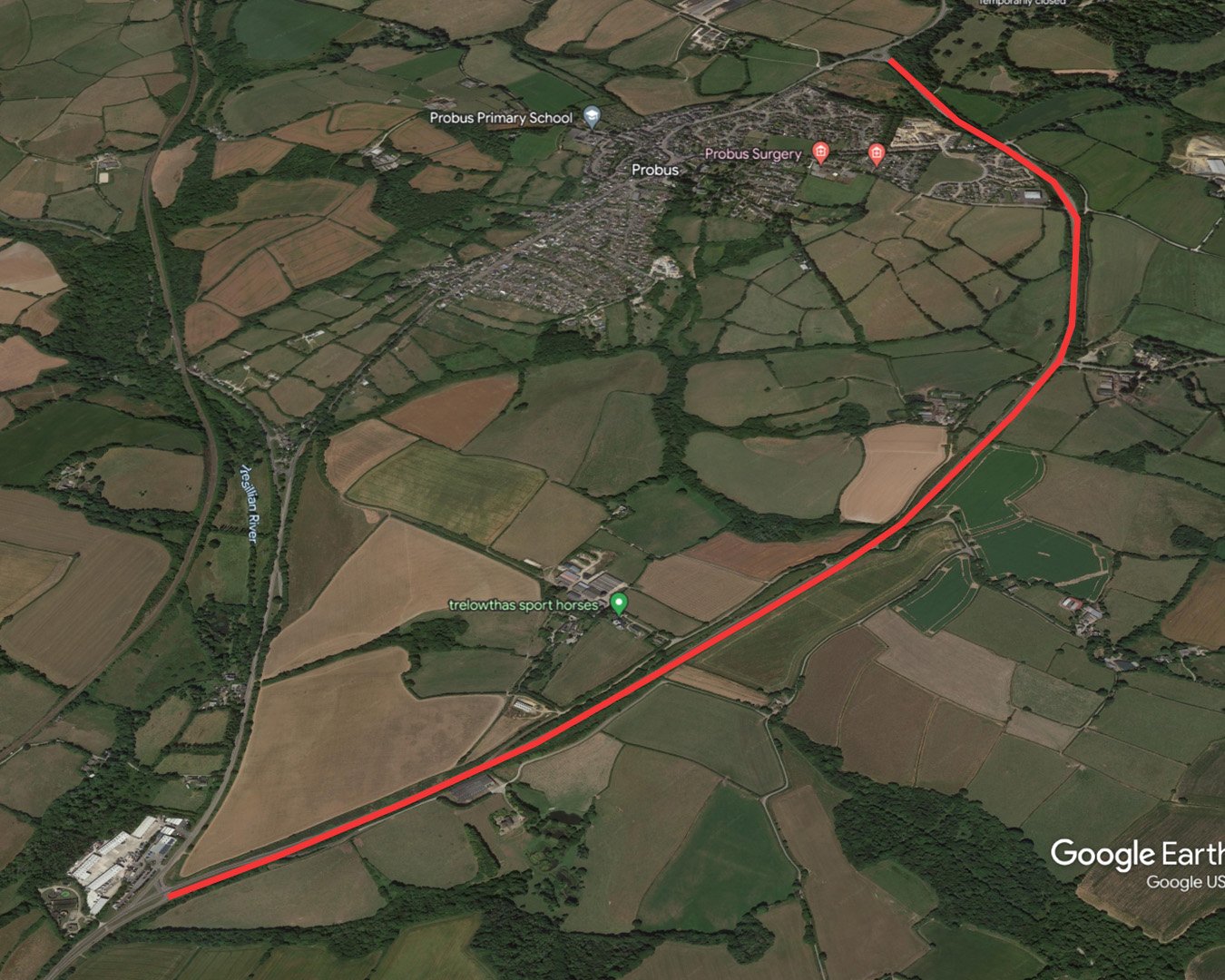
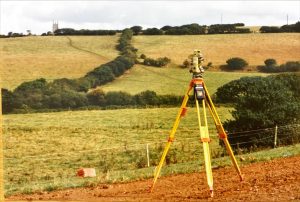
Probus by-pass consisted of 4km of single carriageway over predominantly farmland south of the village. There was only one structure which was a reinforced under pass just east of the Roseland junction. This was part of the accommodation works enabling stock to move safely across the road. The western tie in was online whilst a new roundabout was constructed at the east.
Kemp were involved from the first day on site. The first task was to locate the survey control established by the original topographic surveyors. Once located it was traversed and checked. Additional control was established to enable setting out to commence. During this period Cormac established their site compound and offices at the Roseland Junction. The remains of the compound are still there, and these days silage bails are stored here
The Cormac site team was led by Andy Newton with the support of Pete Talling and Colin Trebilcock. Bill Baxter was their site QS with whom we had worked on the A30 Mitchell-Summercourt By-Pass a few years previously. The Kemp team consisted of Scott Kemp, Jan Fazakerley, Rob Chubb and Barry Osborne.
Once survey control was checked and established setting out could commence.
Printouts of the horizontal and vertical design alignments, crossfalls and widths were interpolated and programmed (by hand) into Psion dataloggers. The design by CCC had employed Moss which later became MX software. This software is still used by some consultants but has increasingly been replaced by CivilCAD over the years. Our Psion loggers communicated by cables in a pre-bluetooth era to our total stations, and data could be shared between staff.
Windows 95 was the new operating system for PCs but we were still using Supercalc on DOS for our spreadsheets at the time, and all of the batter rail schedules were calculated with this.
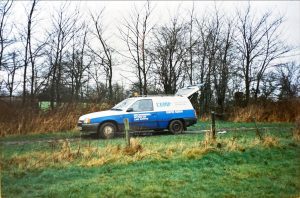
January 1995 saw the commencement of the A390 probus by-Pass. The scheme was designed by Cornwall County Council’s Highways department and was constructed by Cormac which was and remains Cornwall Councils in house direct labour service and civil engineering contractor.
The road was designed to by-pass the village of Probus which lies between Truro and St Austell in Cornwall. It was part of the general upgrade of the Truro to St Austell route that had already seen the village of Sticker by -passed by the now defunct contractor DMD from South Wales. Incidentally another project that Kemp set out.
Setting out of centre lines for hedge breaks commenced and was quickly followed up with fence lines and batter rails for earthworks and soil strip. We commenced at the western end of the project and worked methodically through the 4km. Scott Kemp recalls the time fondly. “I had spent the previous 12 months working on lane rental motorway maintenance projects on the M4 and M5 and the early days of Probus with a land rover and a total station in the peace and quiet of Cornwall was delightful, especially as I was a resident of Probus at the time”.
Earthworks followed the initial setting out. Cormac contracted John Jones Excavations, part of the Vinci group, for the muckshift. They had resource readily available having been engaged by Tarmac on the A30 Indian Queens By-Pass.
 The Kemp team looked after the ongoing setting out for the earthworks along with monthly surveys and measures. Digital ground modelling techniques were employed with our DGM3 software comparing volumes computed by Jones’s Blue Moon software.
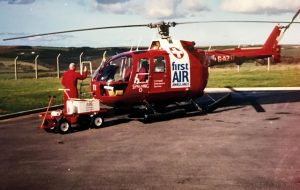
Cormac undertook the drainage works as the earthworks reached formation level. Tragically during the pipelaying through the hard dig cutting west of the Roseland Junction a trench collapse occurred that resulted in the death of Cormac employee Phil Vickery. The air ambulance landed on the site and whilst Phil was extracted from the collapse he tragically died whilst in transit to Treliske. Naturally work stopped on site and the mood remained sombre among the site team for many weeks and months that followed the incident.
Road construction pushed on through the summer of 1995 with formation cut and sub-base trimmed. The scheme saw one of the early uses in Cornwall of slip formed concrete drainage edge channels. Slip forming was something that Kemp were very familiar with having experienced it being used extensively on motorway maintenance projects since the early 1990s.
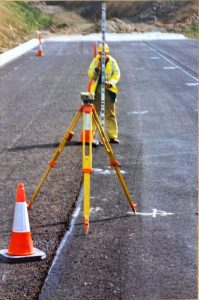
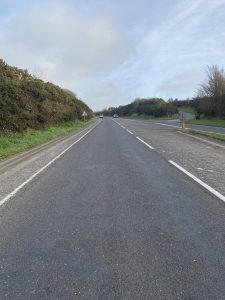 The setting of wire to an offset horizontal and vertical alignment was required and despite the advances in machine control tis techniques is still being used extensively today.
Cormac’s own surfacing division were responsible for the laying of the tarmac throughout the project with final levels on the wearing course being achieved to the 6mm highways specification. Surfacing line and level was controlled by pulling fishing line tightly between kerbs or off set steel pins and dips measured from the wire to the surface to enable the required thickness of material to be laid to be sprayed on the ground. This would typically be every 10m and Cormac’s screwman would adjust the paver accordingly as it approached each dip.
The involvement by the Kemp team finished in the autumn of 1995 with Cormac and John Jones working on verge finishings, signing and white lines. The scheme opened completely over the winter, relieving the village of the heavy traffic flows that had blighted the community for years. Similarly commuters travelling between Truro and St Austell were able to travel freely between the two towns.
Since the by-pass was built Probus has thrived as a village with new housing developments taking place which support a farm produce shop, fish and chip shop, convenience store, pub and filling station. The local surgery has gone from strength to strength as has the primary school. SJ Grigg built a bespoke motor repair workshop adjacent the by-pass soon after it opened allowing them to move out of their small village workshop.
We’re so pleased to share that we have another Chartered Surveyor in our team.A big congratulations to Rich, who has

Ian has been part of the Kemp team for nearly 20 years, joining us in March 2007 after studying Construction

We’ve just added two new vehicles to our ever-growing fleet, supplied by Hawkins Motors. With our team constantly on the


